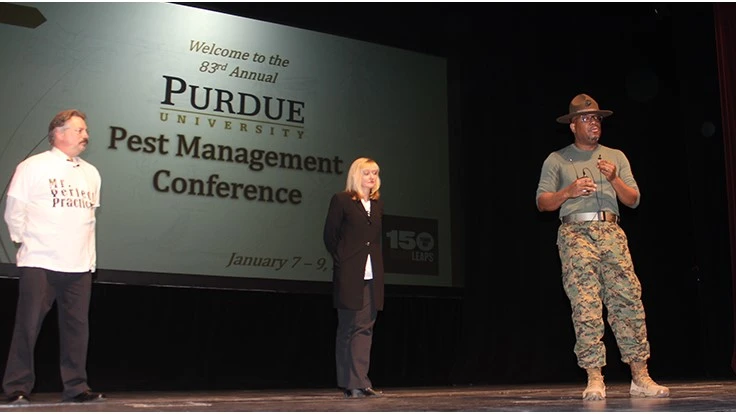
(Photo: FMC's Arnold Ramsey, left, presented along with Dini Miller, center, and Mark Sheperdigian)
WEST LAFAYETTE, Ind. — An important goal of the annual Purdue Pest Management Conference is to provide attendees with information they need to help move the pest control industry forward. This year’s conference, held last week at Purdue University in West Lafayette, Ind., was highlighted by industry experts who presented on a variety of cutting-edge pest management topics.
Kicking off last week’s program was a Pi Chi Omega-sponsored session titled “The Avengers,” which examined the important role technicians play in safely applying products and protecting health, property and food. For this session, Arnold Ramsey, FMC; Dini Miller, Virginia Tech University; and Mark “Shep” Sheperdigian, Rose Pest Solutions; played the roles of Sgt. Safety (Ramsey); Habit Hero (Miller) and Mr. Perfect Practices (Sheperdigian).
Ramsey, a U.S. Marine, discussed common safety mistakes service technicians make and how to avoid them. Some of the hazards he reviewed included: Insect stings and allergens — Ramsey noted that 2 million Americans are allergic to insect stings and that allergens can be found in certain foods, plants, pollen, micro-organisms, medicine, etc.; Attics — Ramsey said attics present PMP threats ranging from broken or damaged ladders to protruding nails in plywood; Crawlspaces — these threats can include structural issues and wildlife pests, as well as the possibility of contaminated soil; and Driving hazards — these include distractions caused by cell phones, something Ramsey says has challenged him. He said he broke the bad habit of talking while driving by keeping his phone in the back seat of his car.
Miller said she would like to see the industry transition away from the term/concept of Integrated Pest Management (IPM), which was developed for agricultural pesticide applications. Instead, she encouraged PMPs to practice what she calls Assessment-Based Pest Management (APM), which involves a thorough investigation and the development of a customized pest control plan. Miller said that the pest control industry needs to improve its professional image and service technicians are the best ones to do so. Miller provided a number of examples of little, but significant actions service technicians can take. For example, pest control companies should encourage residents to be on site whenever possible, so that technicians can ask questions, explain their intended actions and answer questions/concerns. “Talk to them before the first treatment. Ask them questions. Let them know how you think. Let them know you are on the same team,” she said.
Sheperdigian kicked off his presentation by reviewing how mice once interrupted the New York Stock Exchange by chewing on and shorting out computer wiring. In another example, Sheperdigian said too many citizens get stung trying to remove nests themselves instead of calling on a licensed PMP who wears a protective bee suit and understands the proper way to remove nests. To further illustrate why a PMP perspective is important, Sheperdigian showed a slide of unset rodent snap traps in a warehouse. To the layperson, this would appear to be sloppy pest management work; pest management professionals in attendance at the Purdue Conference understood that the unset traps were part of a pre-bait strategy.
Another highlight was a rodent tract presented by Claudia Riegel of the New Orleans Mosquito, Termite and Rodent Control Board (NOMTRCB) and industry consultant Dr. Bobby Corrigan. Riegel reviewed how NOMTRCB is using video and other electronics to measure rodent populations. She said it’s an exciting time for PMPs doing rodent work because they can use a mix of old and new technology and products. For example, she said NOMTRCB reviews video footage of rodent activity to observe how rodents approach traps and choose which baits they prefer; PMPs then adapt their strategies accordingly. She also showed how this technology can help with client “buy in.” For example, NOMTRCB was able to get a client to seal off an open pipe after she showed the client video of a rat emerging from the open pipe. Corrigan built off Riegel’s presentation, noting that with the advent of video and electronic rodent monitoring, “We are learning that we have woefully underestimated the complexity of rodent infestations, colonies and populations.” He encourages PMPs to use this equipment, record results and rethink their rodent control strategies, particularly when it comes to rodent bait station placement. As effective as this technology is, however, Corrigan said these are tools, and there is no substitute for smart, well-trained service professionals who will get on their hands and knees and crawl in tight spaces. For example, a simple trap placement tip he provided attendees with was to position traps in areas where they’ve discovered rodent droppings.
This year's conference also featured presentations on termites, bed bugs, cockroaches, ants, flies, wildlife pests, mosquitoes and more, as well as an exhibit hall filled with the latest product innovations from industry suppliers. Another highlight of this year’s show was tours of Purdue’s entomology labs, in which attendees got to see first-hand some of the work being done by Purdue students and researchers.

Latest from Pest Control Technology
- Earn CEUs from Your State at Next Week’s Mosquito Control Virtual Conference
- Preserving Culture, Providing Opportunities Key in Hoffman’s Decision
- Winter Weather Could Decide How Bad Mosquito Season Gets
- Trent Frazer Discusses How Mosquitoes Survive Winter
- Barnes Exterminating Acquires Tennessee Pest Solutions
- Pest Index Up 9% YOY in January
- Arrow Exterminators Acquires Hoffman's Exterminating
- PMPs Plan Mera Peak Summit for Parkinson's





