Brad Harbison
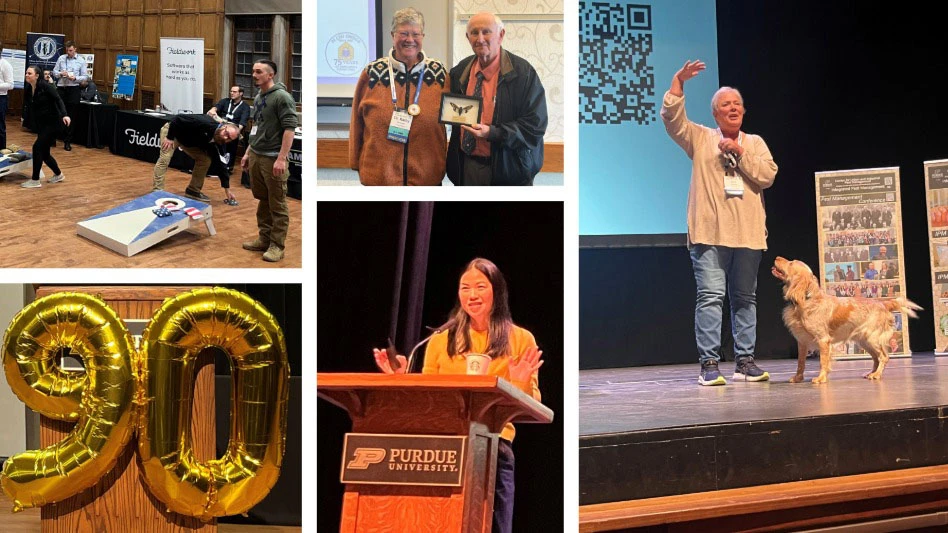
WEST LAFAYETTE, Ind. – Purdue University’s Pest Management Conference returned to campus this week celebrating 90 years of advancing education, innovation and collaboration in the pest management industry.
This year’s conference has brought together industry leaders, researchers and practitioners for three days of expert presentations, panel discussions and networking centered on the theme “Tradition Meets Innovation.”
Hosted by Purdue’s Center for Urban and Industrial Pest Management and the College of Agriculture’s Department of Entomology, the conference dates to 1937 and remains one of the longest-running events of its kind in the nation.
Department of Entomology Head Catherine Hill said the anniversary underscores the conference’s enduring role as a bridge between research and real-world application. “For 90 years, this conference has connected foundational knowledge with emerging ideas, and research with application,” Hill said. “That balance of honoring tradition while embracing innovation is precisely why this meeting continues to thrive.”
More than 300 attendees and 30 exhibitors are in attendance this year, including Purdue alumni, industry partners and thought leaders. Hill noted that the event reflects Purdue’s longstanding partnership with the pest management community and its shared commitment to preparing professionals for increasingly complex challenges. “The mission remains the same,” she said. “Excellence in education, excellence in research and collaboration that helps move the industry forward.”
Highlights from today’s sessions included:
Mark Vanderwerp and Isabelle Lucero delivered a humorous, live “Pest Year in Review” segment highlighting some of the most memorable pest-related headlines of 2025, blending real science with satire. Framed as a mock news broadcast, the segment traced the tradition of using humor to reflect on industry developments, a format dating back decades at Purdue. Lucero joked about being “on assignment” in Iceland, where mosquitoes were reportedly detected for the first time, while Vanderwerp riffed on futuristic science, including the bioengineering of a “woolly mouse” as a step toward reviving mammoths. Perhaps the least surprising headline to make the duo's list was the December viral raccoon story from Virginia in which an allegedly intoxicated "trash bandit" was found in a liquor store bathroom. Vanderwerp and Lucero treated the story as a tongue-in-cheek true-crime mystery, complete with conspiracy theories and a surprise raccoon “guest.”
Jody Green of the University of Nebraska–Lincoln Extension presented “The Tick Talk: What Every Pest Professional Should Know,” in which she explored the importance of ticks as a public health and pest management concern. Green noted that accurate species identification is critical because different ticks transmit different diseases. She focused on the major tick species affecting the Midwest, including the American dog tick, lone star tick and black-legged tick, along with their seasonal activity and associated pathogens. Green underscored that ticks can transmit multiple diseases, often with flu-like symptoms, and that disease risk increases the longer a tick is attached. The emerging alpha-gal syndrome, a potentially life-altering red-meat allergy linked to lone star tick bites, was discussed by Green, who also provided practical guidance on tick prevention, safe removal, personal protection, pet care and landscape management. She emphasized education, early prevention and client communication as essential components of integrated pest management.
Bobby Corrigan’s “Rodent Control in 2026” presentation stressed science-based rodent management, arguing that pest control must evolve alongside rapidly advancing knowledge and technology. Corrigan explained that rodents exhibit strategic thinking, learning and adaptability, making simplistic trap-and-bait approaches unreliable. Corrigan said house mice are not “minor” pests compared to rats. In fact, Corrigan said the house mouse is possibly the most difficult commensal rodent to control due to its small size, ability to live without free water, rapid reproduction and use of hidden interstitial spaces that humans rarely access. Mice can avoid traps, learn from failed attempts and exploit complex building voids where breeding occurs unseen. Leaving even a single breeding female can restart an infestation. Corrigan encouraged attendees to practice integrated rodent management grounded in behavioral science, data and technology.
Dan Collins’ presentation emphasized that effective rodent control begins with advanced inspection tools and behavioral understanding, not traps alone. Collins said rodent jobs are never identical and that mice and rats often travel much farther than textbooks suggest, especially in agricultural and industrial settings. He highlighted essential tools such as UV flashlights to detect active urine trails, fit gauges and rulers to assess entry points, mirrors for void inspections and thermal imaging to locate rodent heat signatures. He also promoted game cameras and remote monitoring to identify where rodents actually live. His key message was that successful control requires observation, technology and targeting rodents at the source.
On the topic of new rodent technology, Kim Camera presented on the use of professionally trained canines to improve rodent control. She explained the difference between detection dogs, which locate rodent signs like feces, urine and nesting, and abatement dogs, which remove rodents outdoors. With an emphasis on certification, observation and understanding rodent behavior, Camera showed how dogs provide information pest professionals cannot see. Through case studies, she demonstrated how observation, mapping burrows, stacking pressure and containment reduce infestations more effectively than traditional methods alone. She said her approach builds client trust, minimizes the use of rodenticides, prevents displacement and helps pest control programs achieve lasting, measurable results.
The Purdue Pest Management Conference continues through Wednesday.
Latest from Pest Control Technology
- Earn CEUs from Your State at Next Week’s Mosquito Control Virtual Conference
- Jody Green Talks Ticks at Purdue Conference
- Truly Nolen Pest Control Promotes Freize, Hackett
- Preserving Culture, Providing Opportunities Key in Hoffman’s Decision
- Winter Weather Could Decide How Bad Mosquito Season Gets
- Trent Frazer Discusses How Mosquitoes Survive Winter
- Barnes Exterminating Acquires Tennessee Pest Solutions
- Pest Index Up 9% YOY in January