Island Conservation
MAJURO, Republic of the Marshall Islands – Native forests are recovering, and seabird populations are soaring on Bikar Atoll and Jemo Islet in the Republic of the Marshall Islands (RMI) thanks to a successful campaign to remove damaging, invasive rats in 2024, said Island Conservation, a nonprofit organization dedicated to restoring island ecosystems. This is a significant step toward realizing the vision of resilient thriving native ecosystems, oceans and communities, the organization said.
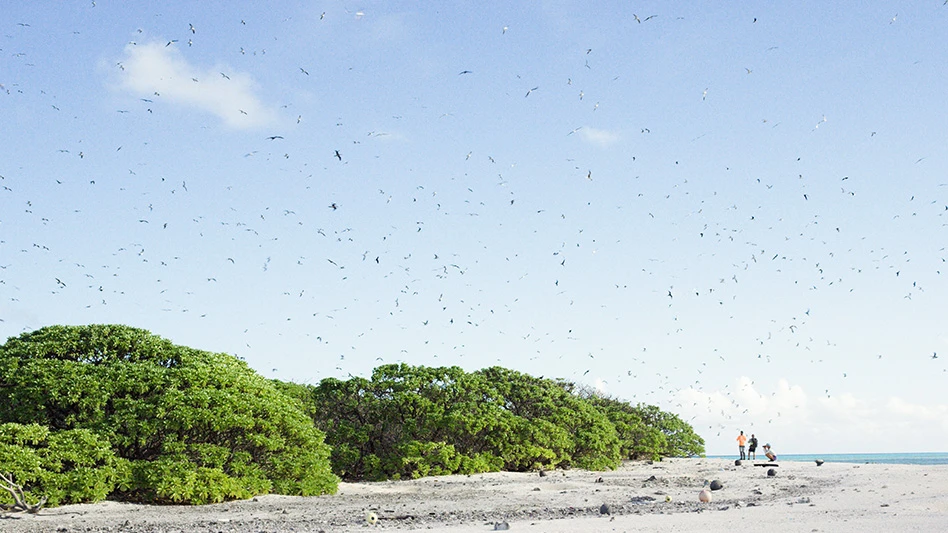
A recent trip to the islands by conservationists from Island Conservation, the Marshall Islands Marine Resources Authority, Ministry of Natural Resources and Commerce, and community members from Utrik Atoll confirmed the 2024 restoration campaign to remove invasive rats was successful. The team found native seabird populations rebounding, restoring the vital nutrient connections between land and sea. Nutrients from seabird guano boost soil fertility, which is beneficial for native plant populations and enrich the surrounding reefs resulting in more fish and, ultimately, greater climate resilience for communities.
“After only one year, the transformation is dramatic. A colony of 2000 Sooty Terns, where there was previously none, were feeding hundreds of chicks,” said Island Conservation Project Manager Paul Jacques. “We also counted 1000’s of native Pisonia grandis tree seedlings across just 60 12m monitored plots on the forest floor — in 2024 we found zero. Native forests are crucial for seabird nesting and are critical to carbon absorption and the island’s ecological health.”
The Republic of the Marshall Islands is leading the way in community-directed conservation by combining terrestrial restoration with marine protection. The ecological gains on land are permanently safeguarded within its expansive Marine Protected Area (MPA), established in January 2025. Spanning 48,000 square kilometers (18,500 square miles), the MPA includes the waters surrounding Bikar Atoll, where the restored terrestrial ecosystems will enrich marine habitats through nutrient runoff, said Island Conservation.
This success is very meaningful to the people of neighboring atolls and island communities, such as the residents of Likiep, who have used Jemo to gather natural resources for generations, said Island Conservation. In recent years, these resources dramatically declined due to invasive rats, making Jemo Islet unusable. Thanks to this restoration effort, Jemo can now support key life-sustaining crops for nearby island communities, the organization said.
This success sets a powerful precedent for future restoration efforts throughout the Republic of the Marshall Islands. Feasibility assessments are underway for Bokak Atoll, a semi-arid ecosystem similar to Bikar. Bokak also lies within the Marine Protected Area. All three of these projects in RMI — Jemo, Bikar and Bokak — are united by their membership in the Island-Ocean Connection Challenge, a volunteer collective created by Island Conservation, Scripps Institution of Oceanography and Re:Wild to restore and rewild 40 globally significant island-ocean ecosystems by 2030.
“Our Marshallese friends continue to add restored, pest-free islands to their list of achievements,” Secretariat of the Pacific Regional Environment Programme (SPREP) Invasive Species Adviser David Moverley said.
“Participating in the first rat removal workshop in Tonga ten years ago allowed them early on to achieve successful eradications on small islands by themselves. Now with modern technology and expert technical support from our partner Island Conservation, they are really pushing the boundaries and people are starting to realize the treasures that abound within the Marshall Islands and the opportunities that they present.”
Latest from Pest Control Technology
- Earn CEUs from Your State at Next Week’s Mosquito Control Virtual Conference
- Preserving Culture, Providing Opportunities Key in Hoffman’s Decision
- Winter Weather Could Decide How Bad Mosquito Season Gets
- Trent Frazer Discusses How Mosquitoes Survive Winter
- Barnes Exterminating Acquires Tennessee Pest Solutions
- Pest Index Up 9% YOY in January
- Arrow Exterminators Acquires Hoffman's Exterminating
- PMPs Plan Mera Peak Summit for Parkinson's





