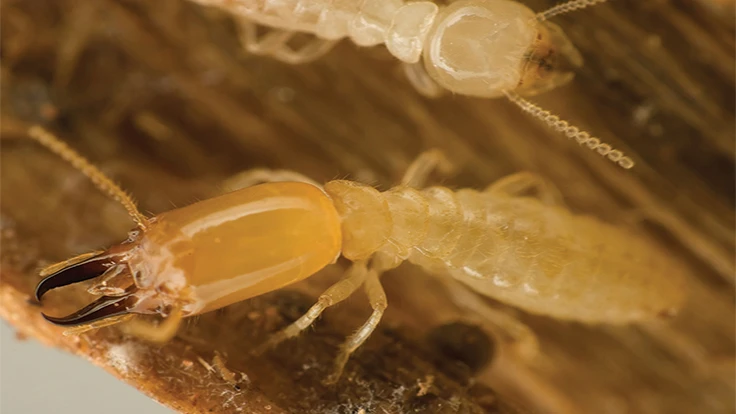
Scientists have discovered termites evolved from cockroaches 170 million years ago, probably in Africa or Asia.
Termites evolved from cockroaches by acquiring the ability to digest cellulose, the main compound in plant cell walls (and wood), and the most abundant organic molecule on Earth.
This ability helped them become one of the most abundant insect groups. Yet when and where they evolved is not well understood.
A team lead by Professor Theodore Evans from the biological sciences department at National University of Singapore has used sequences of mitochondrial genomes from 48 termite species from all termite families and subfamilies from around the world and to determine the timing and locations of major steps in termite evolution.
The team created the most robust phylogenetic (family) tree for termites to date, showing that termites split from cockroaches about 170 million years ago in the mid-Jurassic period. That’s when Pangea, the ancient single continent, was in the process of breaking up.
The results suggest termites are 35 million years older than the oldest known fossils.
The findings appear in Molecular Biology and Evolution.
Source: National University of Singapore
Latest from Pest Control Technology
- Earn CEUs from Your State at Next Week’s Mosquito Control Virtual Conference
- Preserving Culture, Providing Opportunities Key in Hoffman’s Decision
- Winter Weather Could Decide How Bad Mosquito Season Gets
- Trent Frazer Discusses How Mosquitoes Survive Winter
- Barnes Exterminating Acquires Tennessee Pest Solutions
- Pest Index Up 9% YOY in January
- Arrow Exterminators Acquires Hoffman's Exterminating
- PMPs Plan Mera Peak Summit for Parkinson's





