AdobeStock
CLEVELAND - Invasive pests, from the spotted lanternfly to the Asian needle ant, made many headlines this year. That’s because they’re spreading rapidly across the United States.
According to a study published in the Annual Reviews of Ecology, Evolution and Systematics and referred to in EcoWatch, invasive species are spreading 100 times faster than native species. Some invasive pests are being noticed more than others by pest management professionals (PMPs) this year, according to a recent PCT reader poll.
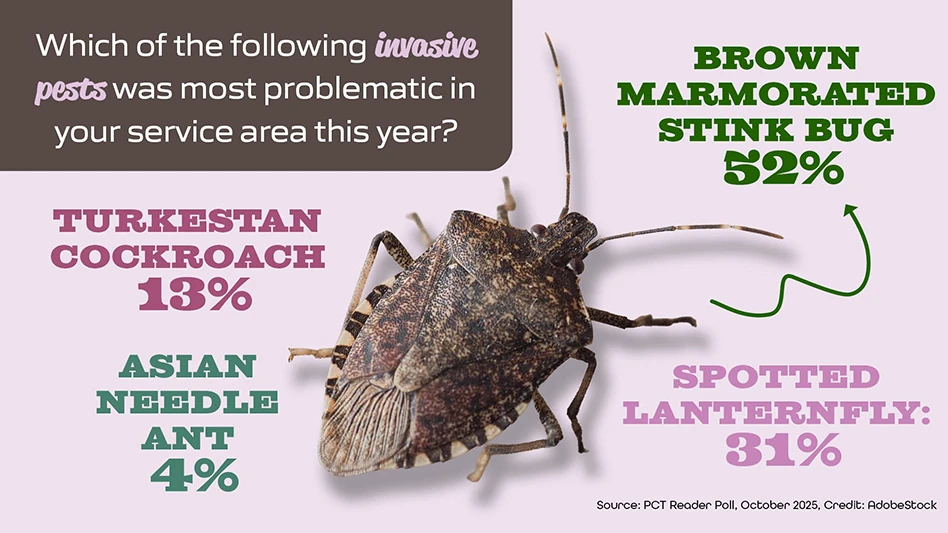
Fifty-two percent of respondents reported that the brown marmorated stink bug (BMSB) was the most problematic invasive pest in their service areas this year while 31% voted the spotted lanternfly as their most difficult invasive pest. Only 13% said the Turkestan cockroach was their most problematic invasive pest and 4% voted the Asian needle ant as invasive pest enemy No. 1.
Regardless of the most problematic invasive pest PMPs have delt with this year, many are focusing on education, proactivity and the use of Integrated Pest Management (IPM) strategies when dealing with non-native pests.
For Bob Gilbert, board certified entomologist at Blue Sky Pest Control in Arizona, the Turkestan cockroach has been on his and the company’s radar. Gilbert said the invasive pest has been in Arizona since 1982 and is well-established in the state, having displaced the oriental cockroach.
Gilbert said he has spotted the Turkestan cockroach in snow-covered mountains north of Phoenix, Ariz., which he said was unexpected because the invasive pest is from the Middle East. Turkestan cockroaches, Gilbert said, are also commonly being found in irrigated areas.
“People are trying to keep grass or citrus trees and flowers. Then most of them have bubble waterers or irrigation and that’s where you’re going to find [Turkestan cockroaches], where’s there’s excess moisture,” said Gilbert.
When treating homes for Turkestan cockroaches, Gilbert said Blue Sky Pest Control’s technicians know to target cool and damp areas. In the areas where Turkestan cockroaches hide, Gilbert said encapsulated pyrethroids, granulated pesticides and mulch can help treat affected residential areas. IPM strategies such as exclusion, using door sweeps and weather stripping have also been important in controlling Turkestan cockroaches, Gilbert said.
“We don’t necessarily find them terribly difficult to control, it’s just that they’re quite numerous and extensive in areas,” said Gilbert. “But we know where to target because of the need for the moisture requirements.”
Invasive pests are adapting to their non-native habitats, and some are even replacing previously dominant invasives. Dr. Kathy Heinsohn, technical and training entomologist for American Pest, an Anticimex company in Fulton, Md., said the BMSB has been replaced by the spotted lanternfly in the Washington D.C. metropolitan area, and was the company’s most problematic invasive pest for the region this last spring, summer and early fall.
The spotted lanternfly, Heinsohn said, causes damage to trees used for lumber (including maple and walnut trees), stone fruit trees, vineyards, soybeans, apples, roses and yard ornamentals. Customers started noticing spotted lanternflies when they emerged in late spring, said Heinsohn, and were “greatly noticed over the summer months.”
Spotted lanternflies feed on tree sap and leave behind gooey, moldy frass on lawn furniture, balconies and other residential areas, Heinsohn said. Over the summer, customers were encouraged to use sticky tree wrap traps to trap adult spotted lanternflies, Heinsohn said, and some of American Pest’s technical staff became certified in ornamental pesticide application (category three) to treat customer’s trees and shrubs.
Although there have been many attempts to control the spotted lanternfly, it isn’t going away. In fact, Heinsohn said because its eggs “can be virtually laid anywhere and overwinter in cold [temperatures] well, they are easily transported over state lines.”
Mark VanderWerp, manager of education and training at Rose Pest Solutions in Troy, Mich., said his team has been talking about the spotted lanternfly and doing training to prepare for it for the past five years.
“[The spotted lanternfly] was probably the biggest noticeable change as far as business wise what we’re seeing and asking about,” said VanderWerp. “But of course that’s a pretty big and recognizable insect. It just looks different than anything else we have that’s a native.”
Education and awareness are important ways to help customers understand invasive pests, VanderWerp said. Invasive pests are here to stay, but the more people, both PMPs and customers alike, understand them, the more opportunities there are to treat them.
“The main thing is awareness because once you can give a name to something, then you can start to talk about it, you can ask questions about it,” said VanderWerp. “That to me is the main thing when you have a new invasive in the area or soon to be in an area — is just to get the word out so people realize that this is a thing and clients are going to start asking about it.”
Latest from Pest Control Technology
- Target Specialty Products Announces Changes to Pest Organizational Structure
- UK Rodent Activity Up 10% Since 2024, Rentokil Reports
- AXN Promotes Simington at Action
- Massey Acquires Nashville-Based PureGuard Pest Solutions
- Suburban Pest Delivers 117 Books Through Its Book Drive
- Anchor Pest Discusses Billboard Marketing
- Pat Hottel Reflects on 90th Purdue Pest Management Conference Theme and History
- MGK Expands Coverage Through New Appointments