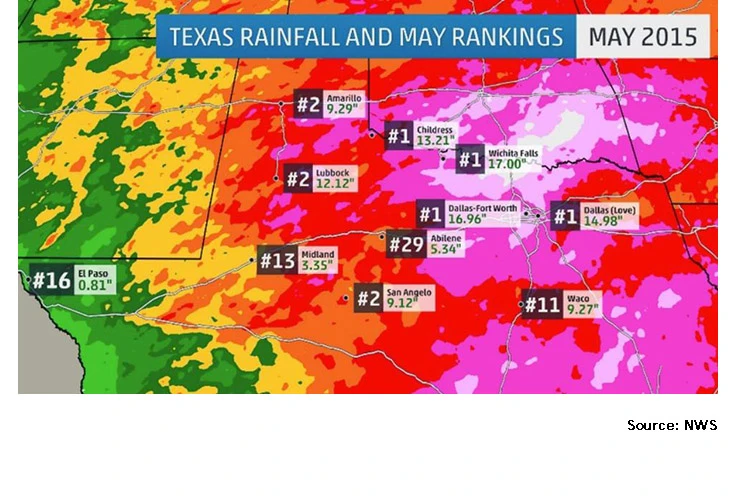
HOUSTON, Texas — According to the National Weather Service (NWS), the month of May was the wettest on record for the state of Texas. In fact, NWS in Fort Worth calculated that Texas-wide May rains amounted to over 35 trillion gallons, an amount that would cover the entire state in water eight inches deep.
The heavy rain, which comes on the heels of a 5-year drought in the Lone Star State, has been a mixed blessing. For residents impacted by flooding the heavy rain has been devastating. On the other hand, the heavy rains replenished essential groundwater and has “greened up” trees and vegetation.
What has the impact been on PCOs? According to PCOs interviewed by PCT, it’s also been a mixed bag. “The month of May was really insane,” said Dauphin Ewart, president of Bug Master, Austin, Texas. “We only had two days in May when it did not rain, so it was really hard to get work done because so much of what we do is outside.”
But now that the heavy rains have subsided, Ewart said Bug Master has been busy. “This first week of June has been one of our busiest in a long time, both in terms of catching up on work that was rolled over from last month as well as new sales. The biggest impact has been administrative – prioritizing when we get to what.”
Ewart said Bug Master is beginning to see an uptick in mosquito control service requests, as has Gary Gillen, president of Gillen Pest Control, Richmond, Texas. Gillenn said, “For those of us in the mosquito business, particularly for cities and counties, we are experiencing dramatic increases in requests for service. Flooding will, no doubt, increase populations of disease-bearing and nuisance mosquitos.”
Pest control industry consultant Jeff Tucker, president of Entomology Associates, Houston, Texas, said he’s received several calls from Texas PCOs inquiring about getting into mosquito work, a result of these PCOs being inundated with requests for this service offering, he surmises. Tucker said this probably will be the segment most active because of the rain. “I think we will continue to see more mosquitoes, at least more than last summer, because there are more pools of standing water in undeveloped areas,” he said.
In addition to mosquitoes, Gillen said American and brownbanded cockroaches trying to escape the rains have become nuisances, in some areas. “I also anticipate increases in ant activity, particularly red imported fire ants (RIFAs),” he said.
What happens to red imported fire ants during flooding is an interesting phenomenon, according to Tucker. “Fire ants will literally ball together and float along the surface until they hit something, like a tree. Unfortunately, people can come into contact with them because they will cling to anything.”
But Tucker, who’s been in the pest control industry 35 years and his seen his share of flooding and heavy rains in Texas, cautions PCOs that extreme weather may not result in the business boon some expect. “There is a ton of bad info out there. Historically, insects have been around for millions of years and they’ve gone through these situations where their life cycles have been interfered with. Correlation does not equal causation. Insects stay pretty steady year round.”
Latest from Pest Control Technology
- Earn CEUs from Your State at Next Week’s Mosquito Control Virtual Conference
- Preserving Culture, Providing Opportunities Key in Hoffman’s Decision
- Winter Weather Could Decide How Bad Mosquito Season Gets
- Trent Frazer Discusses How Mosquitoes Survive Winter
- Barnes Exterminating Acquires Tennessee Pest Solutions
- Pest Index Up 9% YOY in January
- Arrow Exterminators Acquires Hoffman's Exterminating
- PMPs Plan Mera Peak Summit for Parkinson's





