
Between overseeing daily operations and working on strategic long-term strategies, pest control operators have a lot on their plates. One task that can get put on the backburner is personal wealth planning. It’s an easy trap to fall into and it’s a potentially costly one.
 Tony Anderson, CEO of ARS Wealth Advisors and a speaker at the upcoming PCT Virtual M&A Conference, shared three mistakes small business owners should avoid when managing their personal wealth.
1. Holding On To Too Much Cash. For many small business owners, personal wealth management is challenging because their corporate structure (S-corps and LLCs) adds complexities to their personal finances. Oftentimes, small business owners struggle figuring out what to do with their cash, so they do nothing with it (aka, “paralysis by analysis”), Anderson said. “They view it as their safety net, so that if something happens to their business at least they will have that cash to fall back on.”
In the minds of many small business owners, cash flowing in and sitting in a bank account provides them with a sense of comfort; investing fills them with uncertainty. “The problem with that is, especially in today’s environment with interest rates so low, cash earns them almost nothing. If you are still working and sitting on all this cash, that cash isn’t working for you; it’s not growing and it’s not compounding. And if you are retired and you are sitting on all that cash, not only is it not growing for you, but you are drawing on it. Then it is only a matter of time before you start drawing on that principal.”
Another reason small business owners sit on too much cash, Anderson said, is emotion. A lot of people sitting on cash are waiting to feel good, whether it is how they are feeling personally or how they are feeling about the stock market, to invest. “If you wait until you feel good to invest, typically you are going to end up buying high and selling low,” Anderson said.
2. Not Using a Financial Advisor. We live in a day and age where unlimited information is at people’s fingertips. Thus, the temptation for many small business owners is to be their own financial planner. Similar to a homeowner performing do-it-yourself-projects, they can be done, but they can be done better by a professional. A better option is for small business owners to work with financial advisors who understand the nuisances of wealthbuilding, said Anderson. “You want to choose a fiduciary advisor,” Anderson advises. “Fiduciary means that, by law, they are working in the best interest of their clients at all times.”
Anderson is a fiduciary advisor, and based on his experiences working with small business owners he assembled a team that includes a CPA who understands taxes and accounting; an business attorney with expertise in contracts; and a trusted fiduciary advisor who navigates the investing environment.
“I recommend this for a couple reasons,” Anderson said. “One, small business owners are working and don’t have the time to devote to it. But it is critical because the end goal is to retire, and to retire you have to have enough money. Second, when you retire you have enough time to [spend investing] but is that really how you want to spend your time - sitting in front of a computer? Where advisors add value is by interpreting data, understanding how it works, and customizing a plan for each client.”
3. Poor Estate Planning. In working with small business owners, Anderson said it is not uncommon to find owners who haven’t done estate planning, and the two biggest reasons are: (1) procrastination – they know they need to do it but keep putting it off; and (2) it’s an unpleasant topic to discuss that can open up family wounds.
Another mistake Anderson sees is small business owners who take the time to establish the trust, but then fail to re-title assets into the name of the trust.
Just as the intricacies of how a small business is structured is critical, so too are the structural intricacies of estate planning. “There are lots of ways to help minimize taxes, avoid probates and ensure that the majority of the assets the person accumulates that upon their passing goes to the people they want it to.”
Anderson recommends that his clients review their financial and tax plans throughout the year and their estate plans every 2-3 years.
The author is senior digital editor & managing editor of PCT and can be contacted at bharbison@gie.net.
| PCT Mergers & Acquisitions Virtual Conference is Aug. 19 Designed for any PMP exploring the possibility of a sale, currently in the market for acquisitions, or laying the groundwork for succession planning, the seventh annual PCT Mergers & Acquisitions Virtual Conference features an exciting new addition this year: a discussion of the essential role of wealth management in ensuring your long-term financial health.CLICK HERE to register. Find out in this half-day conference featuring some of the leading minds in the industry, veterans of the M&A and financial management markets, each with decades of practical experience counseling PMPs and other successful entrepreneurs. If you would like to learn more from M&A “insiders” with a proven track- record of building wealth, you’re in luck. This year’s list of instructors reads like a “Who’s Who” of the M&A marketplace including Kemp Anderson, founder and president, Kemp Anderson Consulting; Paul Giannamore, managing director, The Potomac Pest Control Group; Dan Gordon, managing director, PCO M&A Specialists; and Tony Anderson, managing partner and CEO of ARS Wealth Advisors. 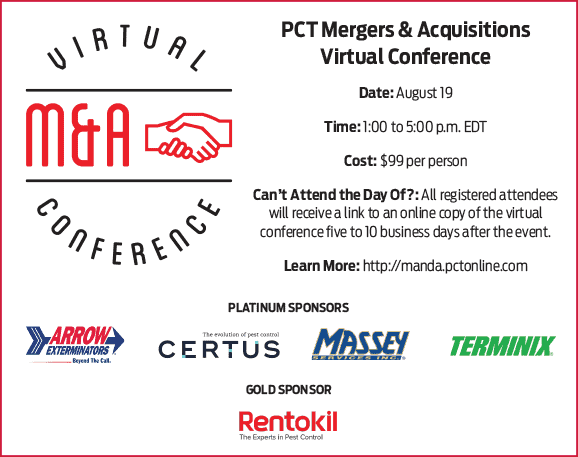 Attendees also will hear from representatives of the event’s sponsors, who will share their company’s philosophy as it relates to mergers and acquisitions. Sessions and speakers include:
|