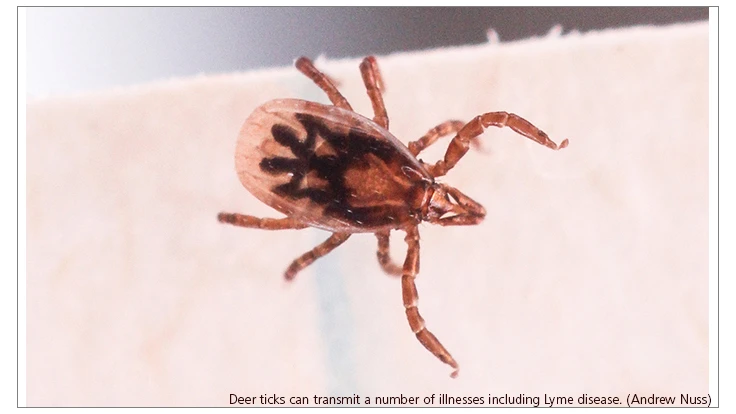
WEST LAFAYETTE, Ind. - An international team of scientists led by Purdue University has sequenced the genome of the tick that transmits Lyme disease, the most common vector-borne illness in North America.
The decadelong project, involving 93 authors from 46 institutions, decodes the biology of an arachnid with sophisticated spit, barbed mouthparts and millions of years of successful parasitism. The genome of Ixodes scapularis, known as the deer tick or blacklegged tick, also sheds light on how ticks acquire and transmit pathogens and offers tick-specific targets for control.
"The genome provides a foundation for a whole new era in tick research," said Catherine Hill, lead author of the paper, Purdue professor of medical entomology and Showalter Faculty Scholar. "Now that we've cracked the tick's code, we can begin to design strategies to control ticks, to understand how they transmit disease and to interfere with that process."
I. scapularis is the first tick species to have its genome sequenced.
The principle genome paper was published in Nature Communications on Tuesday (Feb. 9) and is available at http://dx.doi.org/10.1038/ncomms10507.
Latest from Pest Control Technology
- Earn CEUs from Your State at Next Week’s Mosquito Control Virtual Conference
- Preserving Culture, Providing Opportunities Key in Hoffman’s Decision
- Winter Weather Could Decide How Bad Mosquito Season Gets
- Trent Frazer Discusses How Mosquitoes Survive Winter
- Barnes Exterminating Acquires Tennessee Pest Solutions
- Pest Index Up 9% YOY in January
- Arrow Exterminators Acquires Hoffman's Exterminating
- PMPs Plan Mera Peak Summit for Parkinson's





