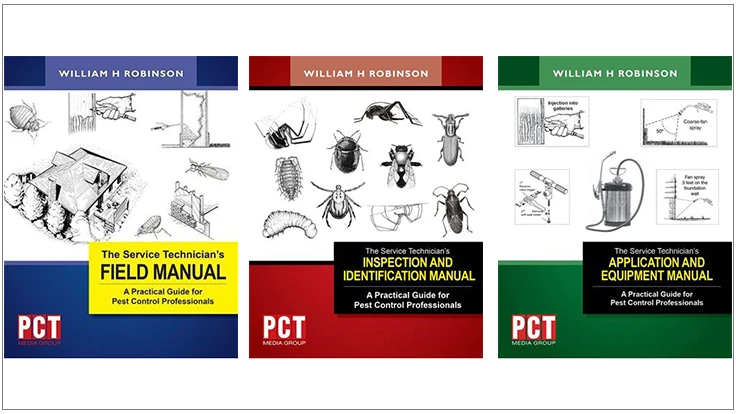
The Service Technician manuals and accompanying materials, authored by William H Robinson and edited by Lisa Lupo, are must-have industry training resources. The set includes three manuals with matching study guides, and slide presentations on a CD. Click here to learn more.  |
Editor’s note: The three-set Service Technician manuals and accompanying materials authored by William H Robinson and edited by Lisa Lupo are must-have industry training resources. The set includes three manuals with matching study guides, and slide presentations (on a CD) and it is next-step training for the next generation of service technicians. Click here to learn more about these training materials.The following article provides an overview of these materials and discusses how they can benefit your company.
The three-set Service Technician manuals and accompanying materials were ‘purpose built’ by two experienced trainers to make it a unique and complete training package. It is designed for new technicians, but will benefit experienced technicians and training managers.
The three manuals cover basic information (217 pages), Inspection and Identification (124 pages), and Application and Equipment (128 pages). The goal of each manual and the complete training program is ‘job readiness.’ Instead of trying to provide everything there is to know, these manuals and this program provide only what you need to know.
Manual Format
The manuals are designed for self-study and learning at a pace determined by the technician. The value of having a hard copy is the opportunity to read, perhaps read slowly, and re-read sections. This can be especially helpful when English is not the native language of the reader. There are important features designed into the manuals that make reading and learning easier.
• Paragraphs length is not more than 12 lines (about 150 words) because this is the ideal length for grasping a topic.
• Paragraphs per page is about 7 because readers can concentrate best on 5 to 7 topics at one time.
• Width of the text on each paragraph is narrow, which enables the reader to see the entire line at one time and easily move through the paragraph.
• Numerous illustrations per page increases learning and takes advantage of the natural habit of distraction—a reader’s mind wanders 20 to 40% of the time. The ‘National Geographic effect’ recognizes that some individuals look at the illustrations first and then read. When the illustrations on the page relate directly to the paragraphs, reading or looking at the illustrations first does not decrease learning.
Memory is naturally strong for drawing and photographs, and the hundreds of illustrations in each manual provide information that can be easily remembered and recalled from memory.
• Wide margins on each page provide ‘white space’ at the margin for notes on the adjacent text. This is useful for trainers that want to add comments relating to company policy or up-dates. This feature helps to personalize each manual and increase its value as a training tool and resource after training.
• Chapters are readable in about 30 minutes, which is the most effective study time for retention of information. This length reduces the ‘fear’ of having to get through a long chapter with many pages of pure text. This ideal length encourages re-reading which increases learning.
Study Guide Format
The study guide that is paired with each manual has a duel purpose: to help the technician and the trainer. The guide was designed as a concentrated review of each chapter in the manual, with the goal of learning and preparing for the short test for each chapter. The Key Points section below the brief chapter summary helps in recalling information. The 10 Things to Know section for each chapter is a quick learning / review exercise when the chapter was read months before. This section is part of the format for the slide presentation on each chapter.
Study guides are also prepared to assist training managers. The Key Points and 10 Things to Know sections can be used as the basis of monthly training or chapter review sessions. The Additional Training Materials section for each chapter is a short list of articles in Pest Control Technology magazine that provide more information on the chapter topic. These articles are accessible on the PCT website (www.pctonline.com). The articles usually provide some practical examples of topics.
Chapter Tests
The tests for individual chapters are designed to quickly confirm that the key points in the chapter have been learned. The 10 True / False questions take about 20 minutes to complete, which leaves time for a group of technicians to grade and review the test with the correct answer sheet that is provided for each test. Following each test with a review session quickly corrects any mistakes and turns the process into a learning experience. Tests now become a learning tool.
Slide Presentation
The slide presentation for each chapter (on the CD accompanying the Study Guide) provides a learning / training tool for the technician and the training manager. The topics in each chapter are featured with illustrations and pictures in 20 to 30 slides. The viewing time is about 20 minutes. The valuable aspect of the slides is that they can be viewed at a slow pace and can be moved backward and forward to grasp information.
Training managers can combine the slide presentation with additional information from PCT articles or slides showing company policy or methods, and create a monthly training session for all technicians.
Training Program
A training program based on separate manuals has immediate and long-lasting benefits to new and experienced technicians. Once the manuals have been read, key paragraphs marked, and notes are made in the page margins it becomes a personal reference book and resource for the technician. A self-study program for technicians is based on the understanding that everyone learns at a different pace, and from visual images and text. These manuals accommodate all types of learning and at any pace. The goal remains the same: to provide effective training for the next generation of service technicians.
21st Century Learning
Training for the 21st century service technician must accept learning methods that are opposite to what traditionally has been promoted, even required, as successful. Learning now benefits from sound research on methods, materials, and the student. The biggest change is that there is no right or wrong way to study and learn. The biggest difficulty will be accepting ideas that are counter to what we’ve been told for generations. Some of this you may already know, now it’s in the textbooks.
Quiet Place and Dedicated Study Area. The concept that it is easy to concentrate without surrounding noise and sitting at the same desk, sounds like the right formula. It has been the standard for years. But research has shown that we can learn effectively with some noise distraction, and by changing study locations. Furthermore, study rituals such as place, time, quiet can slow the learning process.
Long Study Periods and No Distractions. Distractions of all sorts can interfere with learning a complicated set of figures or facts, when strict attention is needed. But brief breaks or distraction can actually help the learning process. Typically, we have to return and read again those paragraphs or points that are not clear. And that repetition can be helpful.
All at Once. The concept of sitting quietly and reading the entire chapter is the best way to learn has also had some critical review—and this may not be the only way to learn. Indeed, the recommendations are not to try to read and learn all at once. Break up the time and the material into small pieces. People learn and remember better when they distribute their study time. It is better to do a little today and a little tomorrow rather than everything at once. This is especially useful for learning new material.
Reading and Re-reading. Re-reading material has some benefits, but it seems that timing is important. Reading and then immediately re-reading a piece of material does not strengthen the memory. Apparently, the brain can get bored when the re-read interval is short, thus little more is added to what was picked-up the first time. Reviewing the material in the chapters using the Study Guide after the chapter has been read (the first time) can increase learning, and reviewing the material a month later also benefits learning. Re-reading is effective, but at the right interval.
Testing as Another Form of Learning. The current concept of tests and testing is that it is a different and effective kind of studying and learning. In fact, each test can be considered an additional study session. The most effective format is not one big test at the end of reading and studying the entire manual, but small tests for individual chapters. Tests linked directly to the chapter increase retention of the material. The study-test-study method of learning is very effective. The effort to prepare and take the test deepens the memory of the subject.
These changes in the traditional learning rules can be reassuring. Technicians will likely benefit from training manuals designed for small pieces of study time at various locations. A few minutes of reading at the end or the start of the work day can be beneficial, and may be all that is needed to get through a chapter. Linking topics in manuals with a technician’s daily work can make learning a part of the job and not an isolated chore.
Latest from Pest Control Technology
- Earn CEUs from Your State at Next Week’s Mosquito Control Virtual Conference
- Preserving Culture, Providing Opportunities Key in Hoffman’s Decision
- Winter Weather Could Decide How Bad Mosquito Season Gets
- Trent Frazer Discusses How Mosquitoes Survive Winter
- Barnes Exterminating Acquires Tennessee Pest Solutions
- Pest Index Up 9% YOY in January
- Arrow Exterminators Acquires Hoffman's Exterminating
- PMPs Plan Mera Peak Summit for Parkinson's





