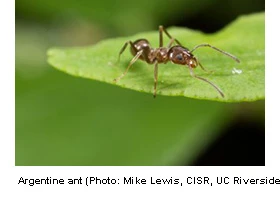
RIVERSIDE, Calif. — Most insects are covered with a thin layer of hydrocarbon molecules as a waterproofing barrier. Embedded in this layer are compounds the insects use as chemical signals for a wide variety of functions such as communicating species and sex.

But isolating these chemicals and determining their absolute configuration and functions has been a challenge.
Now a team of scientists at the University of California, Riverside has devised a straightforward method for purifying these compounds that could result in new “green” methods of controlling pest species, like ants, by disrupting the organization of their colonies.
The researchers devised a technique that combined known fractionation methods with reverse phase high performance liquid chromatography – powerful tools in analysis. Specifically, they used their method to isolate 36 pure hydrocarbon molecules from the complex blends of 20 randomly chosen species in nine insect orders.
The compounds can now be conclusively identified, and the effects of the individual chemicals can be tested.
For more information, visit: http://ucrtoday.ucr.edu/26641
Latest from Pest Control Technology
- Earn CEUs from Your State at Next Week’s Mosquito Control Virtual Conference
- Preserving Culture, Providing Opportunities Key in Hoffman’s Decision
- Winter Weather Could Decide How Bad Mosquito Season Gets
- Trent Frazer Discusses How Mosquitoes Survive Winter
- Barnes Exterminating Acquires Tennessee Pest Solutions
- Pest Index Up 9% YOY in January
- Arrow Exterminators Acquires Hoffman's Exterminating
- PMPs Plan Mera Peak Summit for Parkinson's





