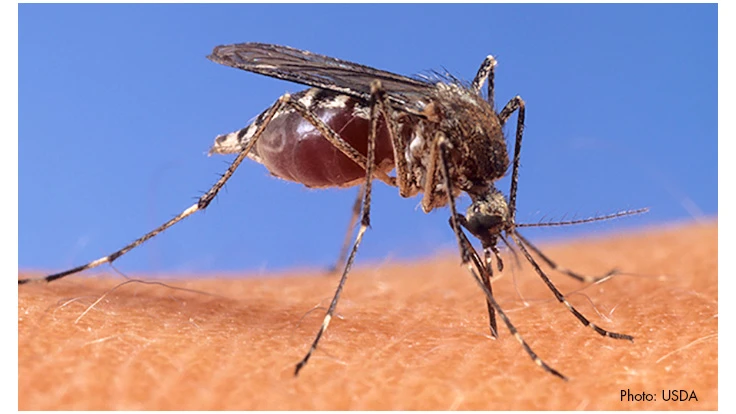
RIVERSIDE, Calif. - Mosquito peak season coincides with summer, which is this true also of Aedes aegypti, the mosquito that spreads dengue fever, chikungunya, Zika fever, and yellow fever virus. To develop its eggs, Aedes aegypti requires a blood meal. One way to control the spread of the diseases this mosquito spreads is to disrupt egg production by tampering with the reproductive events that follow its blood meal.
A team of scientists at the University of California, Riverside has explored this at the molecular level. They focused on microRNAs, small regulatory RNA molecules, which play a critical role in mosquito egg maturation. Specifically, they studied microRNA expression in the Aedes aegypti fat body—the metabolic center that plays a key role in reproduction.
Since proper functioning of the fat body is essential for the development of the female reproductive system after a blood meal, identifying which miRNAs are important to fat body functions, and what specific genes they target, can help design ways to manipulate the levels of microRNA or their targets, affect their interactions, disrupt mosquito reproduction, and thus prevent the spread of diseases the mosquitoes transmit.
The researchers observed five major microRNA expression peaks within a 48-hour period following the female mosquito’s blood meal, indicating that these miRNAs, in turn, may be establishing significant changes in expression of key genes during this period in the fat body.
Fedor V. Karginov, an assistant professor of cell biology and neuroscience, co-led the research team along with Alexander S. Raikhel, a distinguished professor of entomology at UC Riverside.
Says Raikhel: “Now that we know these genes, we are a step closer to controlling the spread of Aedes aegypti by disrupting a key process in the reproductive cycle: egg production.”
Similar approaches to disrupt egg production should be applicable to other mosquito species.
“If the same microRNAs and their mRNA targets are involved in the egg development, which is likely, interfering with them should give similar results,” Karginov says.
For more information, please visit: https://ucrtoday.ucr.edu/44755
Latest from Pest Control Technology
- Earn CEUs from Your State at Next Week’s Mosquito Control Virtual Conference
- Preserving Culture, Providing Opportunities Key in Hoffman’s Decision
- Winter Weather Could Decide How Bad Mosquito Season Gets
- Trent Frazer Discusses How Mosquitoes Survive Winter
- Barnes Exterminating Acquires Tennessee Pest Solutions
- Pest Index Up 9% YOY in January
- Arrow Exterminators Acquires Hoffman's Exterminating
- PMPs Plan Mera Peak Summit for Parkinson's





