UF Institute of Food and Agricultural Sciences (UF/IFAS)
What if one of the biggest threats to your city’s tree canopy isn’t just hurricanes — but also termites?
A five-year partnership between the city of Fort Lauderdale and University of Florida scientists has uncovered a costly termite infestation in public parks. In response, researchers tested a cost-effective approach to limit the negative impact of termites. The result was a pilot study that demonstrated how termite management in urban forests isn’t just possible — it’s essential.
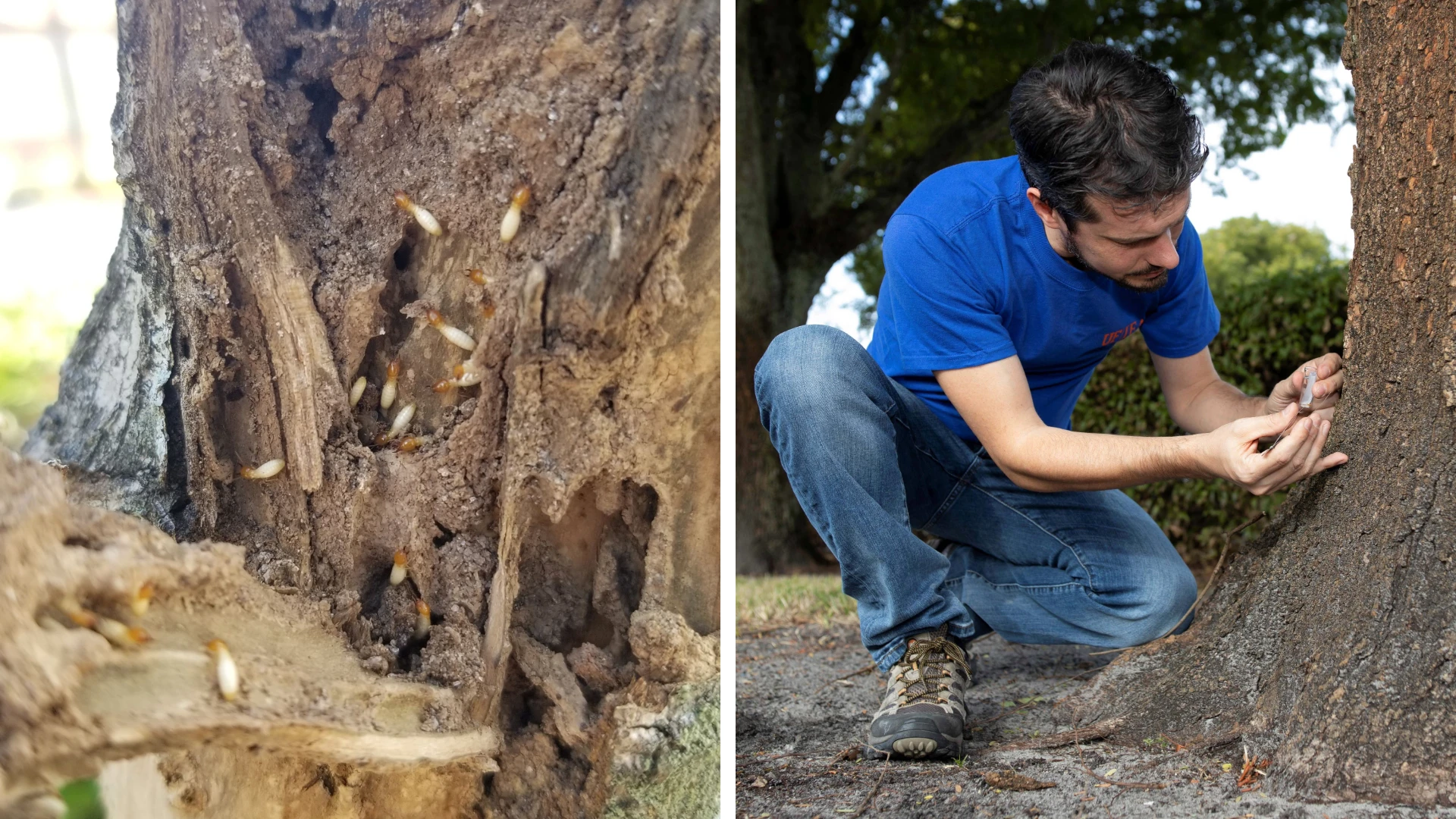
Two of the world’s most destructive termite species, Asian subterranean termites and Formosan subterranean termites, were the culprit. Termites are not only infesting homes, buildings and neighborhood trees, but are also silently hollowing out live trees across South Florida parks.
Scientists at the UF Institute of Food and Agricultural Sciences (UF/IFAS) injected an experimental termite bait into infested trees. The study published in the Journal of Economic Entomology showed that live trees, especially in public spaces, are also highly vulnerable — and in some cases, more at risk because infestations are harder to detect until it’s too late.
“The study offers a blueprint for cities across the Southeast to protect their urban forests from this silent but serious threat,” said Thomas Chouvenc, associate professor of urban entomology at the UF/IFAS Fort Lauderdale Research and Education Center (FLREC). “Our initial effort primarily focused on minimizing the impact of these invasive termites on homes across South Florida communities. However, it has become obvious that trees are also at risk of damage.”
While trees on private properties can be inspected by homeowners or their pest management provider, trees on public land have not received as much attention, he said.
In 2019, Chouvenc reached out to the city of Fort Lauderdale Parks and Recreation Department to come up with a plan to reduce the potential loss of trees in city parks, which led to the experimental pilot project partnership.
Using inspections and targeted treatments in eight Fort Lauderdale parks, the team monitored more than 1,300 trees. Over five years, scientists successfully eliminated all detectable termite colonies twice. But reinfestations occurred, highlighting a need for permanent monitoring programs.
“While we demonstrated that we can sustainably reduce the termite populations in city parks, ongoing monitoring and action will be necessary in the decades to come to continue providing protection to trees,” he said.
Among 1,304 trees monitored, 162 were found to be infested by termites. Treatment with the specialized bait eliminated all detectable colonies, but about 15% of the previously treated trees were reinfested within three years. In total, 5.72 kilograms (12.61 pounds) of termite-specific bait was needed — using minimal pesticide while protecting public trees over wide areas, he said.
Though the bait formulation used in the study is not yet commercially available, researchers say that above-ground bait products can still be used effectively, especially in more concealed or private spaces.
“Once detected, termite colonies were then eliminated with a small amount of the bait formulation,” said Chouvenc. “This inspection-treatment approach allowed us to bring a surgical method to a growing problem, saving one tree at the time.” The study also found signs of crossbreeding between the two termite species, a first-of-its-kind finding in the United States, with unknown consequences for future pest management.
“We now know that that there is a way to give trees a chance against a mounting termite threat,” said Chouvenc.
Researchers emphasized that while these results are promising, the problem is persistent. Without a regular monitoring and treatment program in place, reinfestations will likely bring cities back to square one within a few years.
“Ultimately, cities impacted by these termites will have to engage in a permanent game of whack-a-mole with termites in trees, to continue maintaining and growing their tree canopy, said Chouvenc
Latest from Pest Control Technology
- Earn CEUs from Your State at Next Week’s Mosquito Control Virtual Conference
- Preserving Culture, Providing Opportunities Key in Hoffman’s Decision
- Winter Weather Could Decide How Bad Mosquito Season Gets
- Trent Frazer Discusses How Mosquitoes Survive Winter
- Barnes Exterminating Acquires Tennessee Pest Solutions
- Pest Index Up 9% YOY in January
- Arrow Exterminators Acquires Hoffman's Exterminating
- PMPs Plan Mera Peak Summit for Parkinson's





