Amanda Joerndt
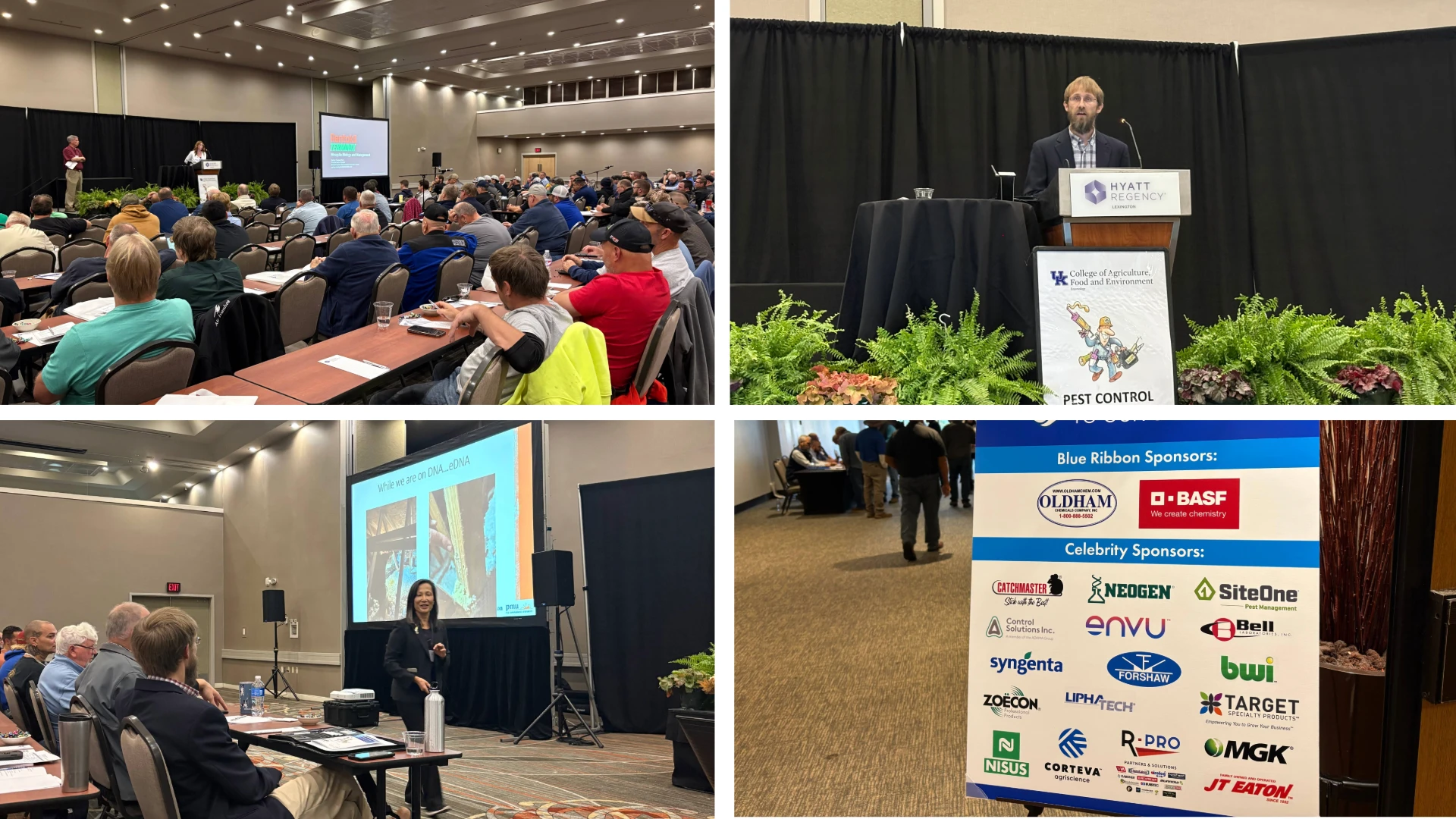
LEXINGTON, Ky. — Hundreds of pest management professionals traveled to the 2025 University of Kentucky Short Course, Nov. 3-6, in Lexington, Ky., to gather industry knowledge and learn about future trends in pest control to better serve their customers, business and employees.
Vendors also exhibited, sharing their latest pest control products, technologies and services.
The conference was hosted by UK’s College of Agriculture, Food and Environment, sponsored by UK’s Department of Entomology in cooperation with Kentucky Department of Agriculture and the Kentucky Pest Management Association (KPMA). Dr. Zach DeVries, associate professor of urban entomology and The Bill Gatton Foundation Early Career Professor at the University of Kentucky, led the three-day event.
“My job is to make sure you receive the best training possible so you can be better at your jobs and to bring people from around the country to give a unique perspective on pest control,” he said. “There’s a lot of good opportunities to meet new people and learn new techniques.”
The goal of this year’s event was to look ahead to the future of pest control and use integrated pest management on a global health scale under one framework: One Health.
Dr. Faith Oi, University of Florida Institute of Food and Agricultural Sciences(UF/IFAS) extension associate professor, said although the future of pest control is in technology and using artificial intelligence, PMPs need to understand basic detection knowledge to understand how pests operate.
“We’re a very visual industry, but we forget to use the sense of smell sometimes in pest detection,” Oi said. “Rodent control is always going to be an important thing for us, but you have to understand the rat’s behavior. Technology will make a well-trained technician better and a poorly trained technician worse.”
Oi defined future-proofing as the design and change of programs to adapt to technological and situational changes. She said what’s going to impact future-proofing is how customers receive information and their eagerness to solve pest problems.
“Future-proofing isn’t about the quality of science, but how we deliver that message,” she said. “As educators, we need to be able to message differently, like having podcasts to share information.”
As protectors of public health, Oi reviewed the One Health framework and said it’s important for more PMPs to have a seat at the table in being a part of the solution for global health issues.
According to the U.S. Centers for Disease Control and Prevention 2025-2029 National One Health Framework report, One Health is a collaborative, multisectoral, and transdisciplinary approach — working at the local, regional, national, and global levels — with the goal of achieving optimal health outcomes recognizing the interconnection between people, animals, plants, and their shared environment.
Oi said PMPs are the implementation arm of the One Health initiative and need to be perceived as such moving forward. “We, as an industry, are viewed as a cost, and not a part of a team. We need to be recognized as part of the solution for global health issues,” she said.
Latest from Pest Control Technology
- Earn CEUs from Your State at Next Week’s Mosquito Control Virtual Conference
- Preserving Culture, Providing Opportunities Key in Hoffman’s Decision
- Winter Weather Could Decide How Bad Mosquito Season Gets
- Trent Frazer Discusses How Mosquitoes Survive Winter
- Barnes Exterminating Acquires Tennessee Pest Solutions
- Pest Index Up 9% YOY in January
- Arrow Exterminators Acquires Hoffman's Exterminating
- PMPs Plan Mera Peak Summit for Parkinson's





