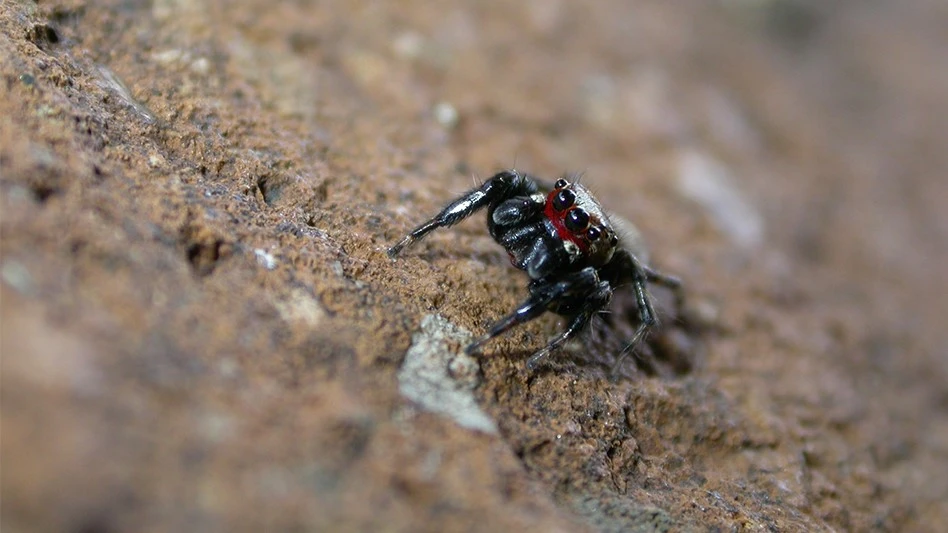
For a creature that – legs and all – might be no larger than a pencil eraser, spiders continue to surprise researchers with their cognitive abilities.
Lisa Taylor, a University of Florida entomologist, has spent her career studying arachnids. She says understanding how spiders think is just one of the unknowns that drives her research.
“They’re such tiny animals, with an even tinier brain, and a sensory system that we don’t quite understand,” she said.
This curiosity led Taylor and two international collaborators – Fiona Cross from the University of Canterbury in New Zealand and Robert Jackson from the International Centre of Insect Physiology and Ecology in Kenya – to examine the dietary preferences of an East African jumping spider known scientifically as Evarcha culicivora. Their findings are newly published in the journal “Animal Behaviour.”
“My collaborators spent years watching these spiders in the field and noticed that they were feeding almost exclusively on mosquitoes,” said Taylor, a research assistant scientist in the UF/IFAS entomology and nematology department. “This isn’t something that’s typical of all spiders -- to specialize in one type of prey.”
Latest from Pest Control Technology
- Earn CEUs from Your State at Next Week’s Mosquito Control Virtual Conference
- Preserving Culture, Providing Opportunities Key in Hoffman’s Decision
- Winter Weather Could Decide How Bad Mosquito Season Gets
- Trent Frazer Discusses How Mosquitoes Survive Winter
- Barnes Exterminating Acquires Tennessee Pest Solutions
- Pest Index Up 9% YOY in January
- Arrow Exterminators Acquires Hoffman's Exterminating
- PMPs Plan Mera Peak Summit for Parkinson's





