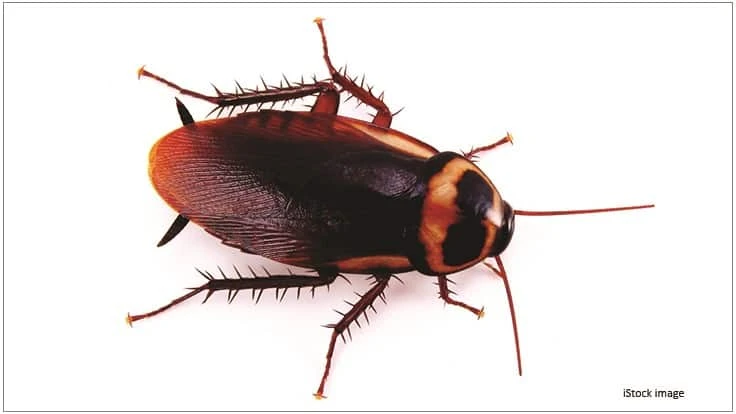
Granular baits help to supplement gel baits on the inside of a structure, as well as to target void areas. They also help to target large roach control and issues on the outside of a structures.
“Granular baits are excellent for exterior perimeters, especially in Florida because of the thick vegetation; they penetrate the vegetation better than most sprays will,” says John Komor, owner of Johnny Bugs in North Port, Fla. Komor supplements exterior sprays with granular baits because of the effectiveness with large cockroaches, like American cockroaches. And they especially help when there’s lots of heavy rainfall.
“This year particularly, was the worst that I’ve ever seen in my 15 years of doing [pest control] with non-stop rain, heat and humidity,” he says. As a result, he began supplementing all outdoor treatments with granular baits. The tremendous rains in Florida were driving large cockroaches out of mulch beds and into peoples’ homes, Komor adds.
Usually a large roach would avoid air conditioning and dry places, but “the surrounding areas were underwater, literally,” he says. In these normal circumstances, Komor utilizes granular baits on accounts with a history of large roaches and typically overgrown vegetation.
Granular baits are extremely effective, but placement must be strategic. “Granular baits are going to stay there for a long time, so you want to be careful with your application, that you’re not applying it in places where people are going to come into contact with it,” says Komor who uses the product in garages and under work benches in addition to the perimeters of yards.
“A number of granular and flake baits, containing boric acid, imidacloprid, fipronil or
indoxacarb, are available for use outdoors to control peridomestic cockroaches. These products
are sprinkled into and around cockroach harborages such as tree holes, firewood, piles
of rocks, landscape timbers, heavy ground cover, and landscape mulch. Such baits are also
effectively used in attics, basements, and crawlspaces to control smokybrown, American,
oriental, and similar cockroaches,” according to the Mallis Handbook of Pest Control.
ON THE INSIDE. Kevin O’Connor, entomologist, Viking Pest Control in Oakdale, N.Y., uses granular baits instead of or in addition to gel baits with indoor cockroach issues based on the application and the application site. “If I’m doing shelving, cracks and crevices, or any inside cabinets, a gel is more efficient and more properly used in those places,” whereas a granular is more effectively used in a wall void, around an exterior or basement, O’Connor explains. He does not place granular baits where kids or pets could potentially come into contact with the substance and track the bait around the house. Inside the house for supplementing gel baits, O’Connor also uses some granular baits for quick, “clean-out situations and problem areas,” and others for regular maintenance, depending on the active ingredients.
Komor also uses granular baits in plumbing voids attached to showers and tubs, as well as attics.
Although David Crenshaw, president and CEO, Crenshaw Pest Control in New Port Richey, Fla., uses “quite a bit of granular bait around the perimeter of the outside of houses and structures,” he treats attics, as well. He explains that in some houses where perhaps “a large canopy of oak trees are over the top” with “a lot of leaves on the roof,” customers could “end up with a pretty significant American or Australian cockroach infestation in the attic.” In those cases, Crenshaw treats the attic with granular baits and “it takes them out,” he says.
Latest from Pest Control Technology
- Earn CEUs from Your State at Next Week’s Mosquito Control Virtual Conference
- Preserving Culture, Providing Opportunities Key in Hoffman’s Decision
- Winter Weather Could Decide How Bad Mosquito Season Gets
- Trent Frazer Discusses How Mosquitoes Survive Winter
- Barnes Exterminating Acquires Tennessee Pest Solutions
- Pest Index Up 9% YOY in January
- Arrow Exterminators Acquires Hoffman's Exterminating
- PMPs Plan Mera Peak Summit for Parkinson's





