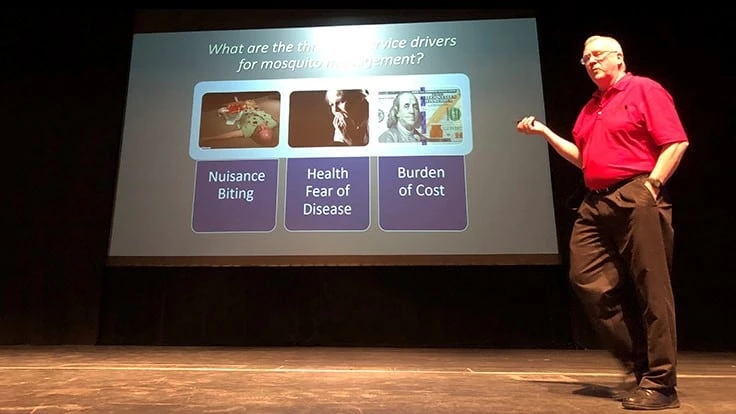
(Pictured, Stan Cope presenting at this year's Purdue Pest Management Conference.)
WEST LAFAYETTE, Ind. – As one of the leading resources for moving the pest management industry, the Purdue Pest Management Conference includes cutting-edge topics, and the lead off technical sessions at this year’s event are of ever-increasing interest to pest management professionals: vector management and pollinator protection.
The vector management session was created by Rentokil’s Gene White and presented by Stan Cope of AP&G, who also is a past president of the American Mosquito Control Association.
Cope noted that vector control remains a growth sector for the pest control industry thanks, in large, to vector-borne diseases that continue to capture headlines. For example, in 2019 mosquitoes were once again in the news as a result of eastern equine encephalitis (EEE) outbreaks.
Many pest control companies are responding for this need by offering mosquito control. For example, Cope and White referenced the 2018 PCT State of the Mosquito Market, which showed that 54% of PMP companies offered mosquito control services in 2018 compared to 38% in 2014.
7. Protect people across the country at work and home from nuisance biting mosquitoes and therefore theoretically reduce disease transmission
Cope said #7 is particularly important. “The bottom line is that our job is to protect people. What people really buy from you is quality of life and peace of mind.”
Cope said barriers to enter the vector management sector are low, as traps and spray equipment are relatively inexpensive and it’s not terribly difficult to know where and how to apply spray pesticides. However, there are some landmines when it comes to offering mosquito control, Cope said, including understanding local regulations; extensive paperwork; and drift concern.
Following Cope was Leo Reed from the Office of the Indiana State Chemist. His presentation on pollinators dovetailed nicely with Cope’s because mosquito spraying is a concern when it comes to pollinator protection. For example, Reed said applicators who spray a customer’s property need to be mindful of that customer’s neighbors, who might be keeping hives (and thus have drift concerns).
In 2014, President Barack Obama announced a federal strategy to promote the health of honey bees and other pollinators. As part of his memorandum, Obama directed EPA to engage with state agencies to develop pollinator protection plans.
Indiana’s plan contains five major components, and it is similar to other states’ pollinator protection plans. The five components are:
5. Promote Best Management Practices (BMPs) for pollinator protection and health
PCT will have additional coverage of the 2020 Purdue Pest Management Conference.
Latest from Pest Control Technology
- Earn CEUs from Your State at This Week’s Mosquito Control Virtual Conference
- Jody Green Talks Ticks at Purdue Conference
- Truly Nolen Pest Control Promotes Freize, Hackett
- Preserving Culture, Providing Opportunities Key in Hoffman’s Decision
- Winter Weather Could Decide How Bad Mosquito Season Gets
- Trent Frazer Discusses How Mosquitoes Survive Winter
- Barnes Exterminating Acquires Tennessee Pest Solutions
- Pest Index Up 9% YOY in January