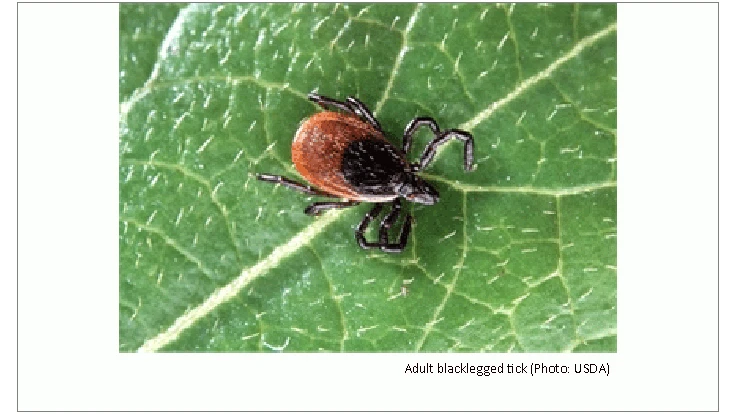
The Vermont Department of Health announced that the state is on pace to hit a record number of cases of anaplasmosis, a disease spread by the black-legged tick.
As of September, there have been 133 cases of anaplasmosis, only six fewer than there were in 2015.
The black-legged tick also spreads Lyme disease. But what makes anaplasmosis notable, said Bradley Tompkins, an infections disease epidemiologist, is that it has a higher hospitalization rate than Lyme.
“Lyme disease is the most commonly-reported tick borne disease in Vermont but only about 3 percent of people with Lyme disease in Vermont end up hospitalized for the illness,” Tompkins said. “If you compare that with an anaplasmosis ... we see about 34 percent of people with anaplasmosis getting hospitalized. So it's a much more severe illness than than Lyme disease."
Unlike Lyme disease’s distinct bulls-eye rash, there are no visual cues associated with anaplasmosis, said Tompkins. The symptoms are pretty generic: ever, headache, muscle aches and joint pain.
No more results found. As of September, there have been 133 cases of anaplasmosis, only six fewer than there were in 2015.
The black-legged tick also spreads Lyme disease. But what makes anaplasmosis notable, said Bradley Tompkins, an infections disease epidemiologist, is that it has a higher hospitalization rate than Lyme.
“Lyme disease is the most commonly-reported tick borne disease in Vermont but only about 3 percent of people with Lyme disease in Vermont end up hospitalized for the illness,” Tompkins said. “If you compare that with an anaplasmosis ... we see about 34 percent of people with anaplasmosis getting hospitalized. So it's a much more severe illness than than Lyme disease."
Unlike Lyme disease’s distinct bulls-eye rash, there are no visual cues associated with anaplasmosis, said Tompkins. The symptoms are pretty generic: ever, headache, muscle aches and joint pain.