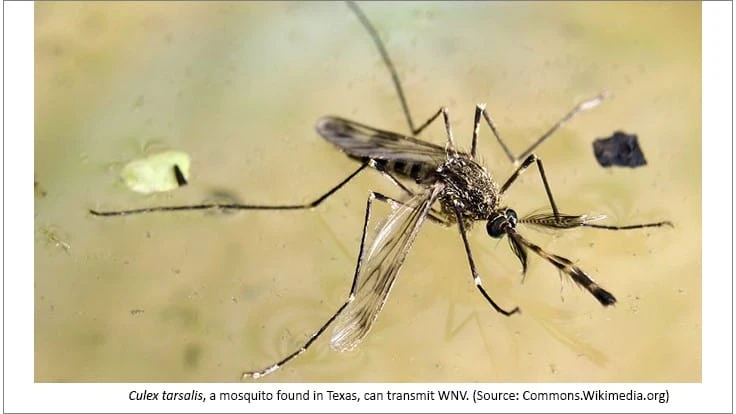
COLLEGE STATION, Texas - The Texas A&M AgriLife Extension Service experts want Texans to be aware of a large rise in mosquitoes testing positive for West Nile virus in Dallas and Tarrant counties.
The state’s warm climate makes Texas a prime breeding ground for vector-borne illnesses, and recent weather conditions have only heightened the mosquito problem for many areas of the state.
“In Texas, our biggest mosquito-related concern is West Nile virus,” said Sonja Swiger, Ph.D., AgriLife Extension veterinary entomologist in Stephenville. “It has been found throughout Texas and the U.S., and even places that don’t normally have a problem like Miami have had cases in 2020. It’s just that kind of a year.”
The West Nile virus also produces symptoms in people that can be similar to some COVID-19 symptoms – fever, cough and sore throat. Anyone experiencing these symptoms should consult their doctor.
“If you think you might have contracted West Nile virus, get tested,” Swiger said. “Do not assume it is COVID-19.”
West Nile mosquito numbers on the rise. “We’re seeing numbers as high in some counties as we experienced in 2012 and that could be problematic,” explained Swiger.
“Tarrant County is currently the hotspot, so to speak, but Dallas County is also starting to see a rise in their number of infected mosquitoes and their vector index,” she said.
“Tarrant County is reporting 30% positive in some areas and 50% positive in the northeast section, which includes the cities of North Arlington, Grapevine, Watauga, Keller and North Richland Hills, to name a few.”
According to Dallas County Health and Human Services, for the week ending Aug.1, 40 mosquito traps tested positive for West Nile Virus. A total of 127 mosquito traps in Dallas County have tested positive to date for the year and there has been one human case reported.
The previous week, Tarrant County reported that 51 trapped groups, or pools, of mosquitoes tested positive for West Nile virus and that there have been 163 positive test pools for 2020 so far.
In 2012, Texas experienced its largest outbreak of West Nile virus in history with over 1,800 confirmed cases.
“Most of these victims reported they were bitten at home,” Swiger said. “So, it’s important that Texans be aware at all times and use repellents when necessary.”
Swiger said without any heavy rains, the Culex quinquefasciatus population will continue to grow without chemical intervention.
“We cannot predict what the next few months will bring unfortunately, but if heavy rains are in the future, we would anticipate a decline in positives, as the mosquitoes would be washed away,” she said.
Latest from Pest Control Technology
- Earn CEUs from Your State at Next Week’s Mosquito Control Virtual Conference
- Preserving Culture, Providing Opportunities Key in Hoffman’s Decision
- Winter Weather Could Decide How Bad Mosquito Season Gets
- Trent Frazer Discusses How Mosquitoes Survive Winter
- Barnes Exterminating Acquires Tennessee Pest Solutions
- Pest Index Up 9% YOY in January
- Arrow Exterminators Acquires Hoffman's Exterminating
- PMPs Plan Mera Peak Summit for Parkinson's





