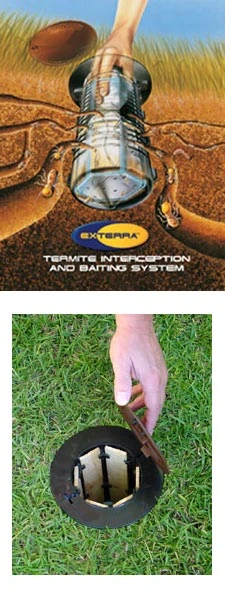
The Exterra Termite Interception and Baiting System is a simplified approach to termite baiting.
The first step in system use is the placement stations around the outside perimeter of the structure. The interior dimensions of the station are 2 5/8 inches square by 6 7/8 in deep. The sides of the Station are perforated to allow termites to enter station when it is placed in the ground. Before installation, the side walls of the station are fitted with wooden interceptors that line the interior of the station leaving a vacant cavity in the middle of the Station. Stations should be placed no more than 20 feet apart and roughly 2 feet from the side of the foundation wall (possibly farther from the foundation if a liquid termiticide has been applied).
To place the station in the ground, a hole slightly larger than the station is dug using either an auger or a post hole digger. Care should be taken to place holes close to known or suspected termite activity, as well as the required maximum 20 foot intervals. Watch out for water lines, utilities and sprinkler systems when selecting hole placements.
The station is next placed into the hole produced by the auger. The hole should be just large enough to allow the bottom of the station to fit in the hole.
It is critical in back-filling around stations that soil is placed against the entire exterior surface of the station. Doing this will assure that termites have free and complete access to the station..
It may be necessary to make a localized application of a liquid termiticide to the soil, or to treat any termite infested structural timbers with an injected termiticide to control any active termites during the initial treatment phase. Extreme care should be taken to avoid application of any insecticide (termiticide or exterior perimeter insecticide) on or near installed stations.
Stations should be inspected at regular intervals as required by the label . It is not necessary to disturb the interceptors when inspecting them. Carefully inspect the interceptors for evidence of mud tubing on the edges, in the corners, or on the surface of the interceptor.
A critical difference between the Exterra and other termite baiting systems is found during the baiting process. When activity is noted in or on the interceptor, it is not necessary to disturb the termites by removing the interceptor . In fact the continued presence of the interceptors means termites should have less reason to leave the Station. In the event termites consume all of the active bait, the cellulose interceptors are still in place to keep them feeding in the station until the applicator returns to service the station.
The bait matrix is placed in the cavity formed by the cellulose interceptors within the center of the station. The termites easily transition from the cellulose interceptors to the bait matrix. Baited stations should be inspected within 45 days of bait placement of bait, and bait should be replenished as necessary.
Within a few months of the initiation of feeding on the bait matrix, the termites will begin to show the tell-tale signs of the effect of the chitin synthesis inhibitor. The termites will appear a pasty white or parchment white color, and you may begin to see a larger proportion of soldier termites than normal. Full effect generally occurs after the termites have fed for 6-12 months. At that time there may be no evidence of termites in the station or interceptors other than numerous soldier head capsules.
When activity has not been observed for a period of 3 months, it will be necessary to remove the old Station, and replace it with a new station, or a clean used station equipped with new interceptors. This is also the time to return to the monitoring phase of the interception and baiting process.