AdobeStock
CLEVELAND – Six million Americans report animal bites each year and 1.6 million receive medical care as a result, according to the Center for Disease Control and Prevention. In general, people are more likely to be bitten by domestic animals such as cats and dogs than by wildlife pests, according to the World Health Organization, but pest management professionals (PMPs) often are encountering wildlife pests and rodents in situations where they feel threatened or cornered.
Most PMPs working with rodents and wildlife animals have avoided being bitten by those pests, according to a recent PCT reader poll.
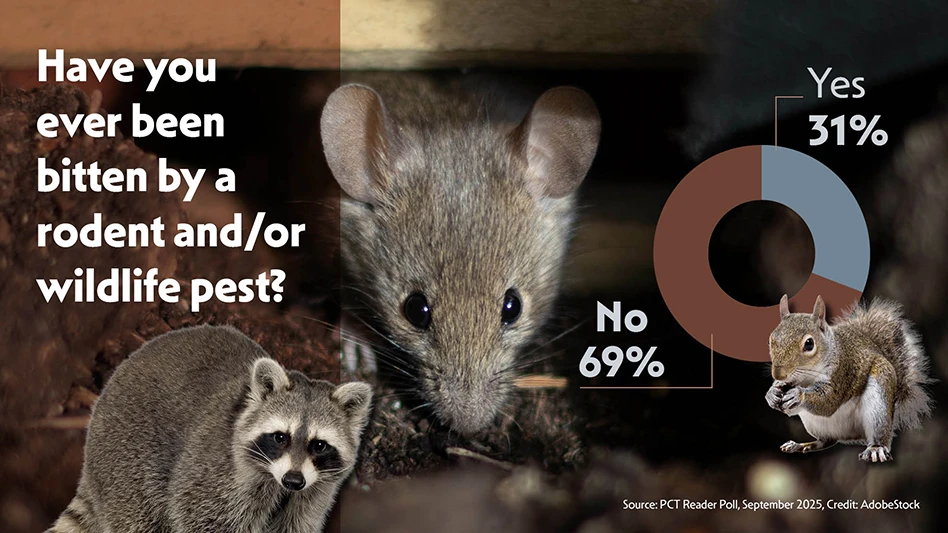
Sixty-nine percent of respondents reported that they have NOT been bitten by rodent/wildlife pests while 31% voted that they HAVE been bitten during their pest control career.
“I got bit by a squirrel,” Lauralee Proudfoot, owner/operator, Cottage Pest Control, Victoria Harbor, Ontario, Canada, commented on a PCT LinkedIn post about the reader poll question. “Do not recommend!”
In a follow-up interview, Proudfoot told PCT the incident happened when she was new to the job. The squirrel was “flattened” in between a vapor barrier and insulation in a customer’s house (the squirrel had been trapped in there for over a day), she said.
After Proudfoot tried cutting a hole and putting a net over it without success, she grew frustrated and grabbed the squirrel, which ended up biting her. Fortunately, the bite wasn’t medically concerning, and she was able to remove the wildlife pest from the home.
Today, Proudfoot said she uses better equipment and unless a rodent or wildlife pest is hard to access, she will set a trap.
Sometimes, accidents happen, and professionals are bitten, but there are ways to be better prepared, and strategies for avoiding painful, and potentially dangerous, animal bites.
The use of personal protective equipment (PPE) depends on the wildlife control situation, but typically this involves wearing long sleeves, long pants, boots, gloves, eye protection and head protection, said Chelle Hartzer, consulting entomologist, 360 Pest Consulting, Lawrenceville, Ga. “I think it’s one of those things that you have to be situationally aware of,” she said.
“If you’re walking into that house that had a huge mouse problem, you know you should probably wear a respirator or at a minimum a dust mask,” Hartzer said. “If you know you’re going into a situation where you’re trying to do a rat cleanout in a big city, you’re probably going to want to put on a little bit more PPE because there’s going to be a lot going on.”
Appropriate PPE, such as respirators, can keep PMPs safe from diseases such as hantavirus if they are working with rodents, Hartzer said. It’s also important for PMPs to remember that PPE and equipment wear down over time and need to be replaced, she said, including materials in First Aid kits.
Jesse Fraser, owner, Critter Control, Merrimack, N.H., has never been bitten by rodents or wildlife pests on the job. Fraser is also the eastern representative for the National Wildlife Control Operators Association, which he said has classes about proper procedures on handling wildlife.
The best way to handle a wildlife infestation, Fraser said, is to set a trap and exclude the animal, and relocate if that is legal in the PMP’s state. “As a wildlife control professional, we want to do what’s best, obviously, for the homeowner, but also for the animal, too,” he said.
If a rodent or wildlife pest is stuck or trapped in a tricky spot of a house, such as a fireplace, it is still best to try and create exits for the animal, Fraser said. Although sometimes PMPs have to grab an animal, it can cause harm to both parties, especially the animal.
In order to keep his wildlife control professionals safe and prepared, Fraser said the company completes respirator fit tests for its staff every other year and everyone has a pre-exposure rabies vaccine. They also get tested every other year to ensure the vaccine is still in their bloodstream.
“Basically, take care of your employees,” Fraser said. “They’re the ones who are working. I’m an owner, but I’m in the field still. But your employees are the ones in the field who are making you money. Take care of them. Invest in them. Give them the proper safety set.”
Participate in PCT’s latest poll question: Which of the following do you think is the most valuable reason for a small business to offer add-on services?
Latest from Pest Control Technology
- Earn CEUs from Your State at Next Week’s Mosquito Control Virtual Conference
- Preserving Culture, Providing Opportunities Key in Hoffman’s Decision
- Winter Weather Could Decide How Bad Mosquito Season Gets
- Trent Frazer Discusses How Mosquitoes Survive Winter
- Barnes Exterminating Acquires Tennessee Pest Solutions
- Pest Index Up 9% YOY in January
- Arrow Exterminators Acquires Hoffman's Exterminating
- PMPs Plan Mera Peak Summit for Parkinson's